
The Best Herbs to Grow on Your Apartment Balcony
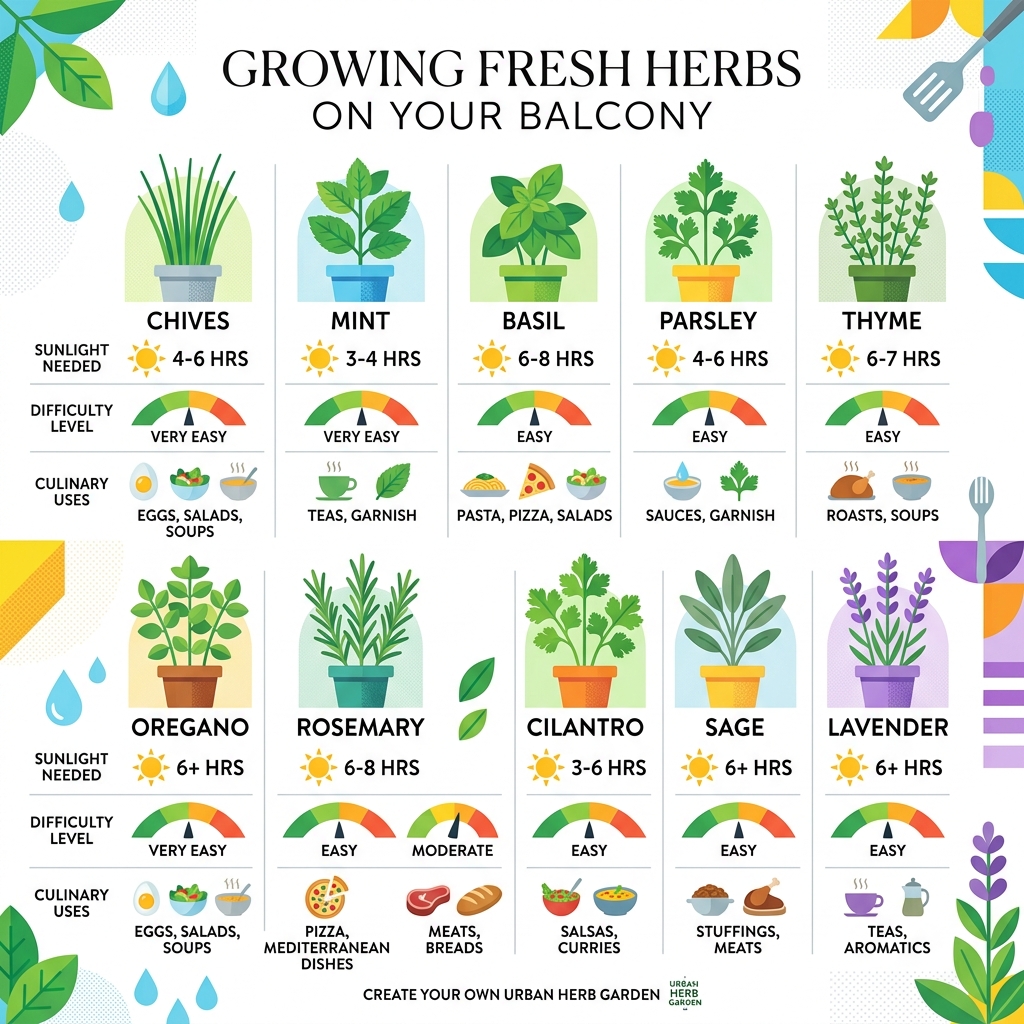
The best herbs for balcony growing are ones that thrive in containers, suit your available sunlight, and actually get used in your kitchen. Here are the top picks:
| Herb | Sunlight Needed | Difficulty | Best For |
|---|---|---|---|
| Chives | 4-6 hrs (shade-tolerant) | Very easy | Eggs, salads, soups |
| Mint | 3-4 hrs (partial shade) | Very easy | Teas, garnish |
| Basil | 6-8 hrs (full sun) | Easy | Pasta, pizza, salads |
| Parsley | 4-6 hrs (partial shade) | Easy | Sauces, garnish |
| Thyme | 6-7 hrs (full sun) | Easy | Roasts, soups |
| Oregano | 6+ hrs (full sun) | Easy | Pizza, Mediterranean dishes |
| Rosemary | 6-8 hrs (full sun) | Moderate | Meats, breads |
| Cilantro | 3-6 hrs (partial shade) | Easy | Salsas, curries |
| Sage | 6+ hrs (full sun) | Easy | Stuffings, meats |
| Lavender | 6+ hrs (full sun) | Easy | Teas, aromatics |
You don’t need a yard. You don’t even need a lot of time. A small balcony — even just a few square feet — is enough to grow a handful of fresh herbs that genuinely change the way you cook.
The biggest mistake most beginners make? Picking herbs based on taste alone, without checking how much sun their balcony actually gets. Match your herbs to your light conditions first, and everything else gets much easier.
On a typical 4×6 ft balcony, you can realistically grow 6 to 10 herb plants using a mix of railing planters, a tiered stand, and a couple of freestanding pots. That’s more than enough to cover your everyday cooking needs.
Choosing the Best Herbs for Balcony Success
When we think about the best herbs for balcony gardening, we aren’t just looking for flavor; we’re looking for “apartment-tough” plants. Balconies can be tricky environments. They often face high winds, intense heat reflected off glass windows, or deep shade from neighboring buildings.
The key to a thriving urban oasis is selecting herbs that are naturally compact or easily managed in pots. For instance, Basil is a balcony superstar because it loves the warmth of a sunny ledge and grows rapidly, providing a high yield for your pesto and salads. Rosemary and Thyme are excellent choices because they are woody perennials that can handle a bit of neglect and wind.
If you are looking for a pop of color and a relaxing scent, Lavender is a fantastic addition. While often thought of as a garden shrub, many varieties thrive in 10-12 inch pots and attract urban pollinators like bees and butterflies to your high-rise haven. On the other hand, Parsley and Cilantro provide essential nutrition and freshness but require a bit more attention to moisture.
For a deeper dive into specific varieties, you can find more info about the best herbs for balcony gardening to help you curate your perfect plant list.

Top 5 Best Herbs for Balcony Beginners
If you’re just starting out, we recommend sticking to the “Big Five.” These are the most resilient herbs that offer the most forgiveness for common beginner mistakes like forgetting to water for a day or two.
- Chives: These are arguably the easiest herb to grow. They are incredibly hardy, tolerate partial shade, and regrow almost instantly after you snip them for your morning omelet.
- Mint: Virtually unkillable. Mint thrives in less-than-ideal light and grows so fast it can provide a continuous supply for teas and cocktails.
- Basil: As long as it has sun and water, basil is a fast grower. It’s a great “teacher” plant because it wilts visibly when thirsty, telling you exactly what it needs.
- Parsley: It’s a workhorse in the kitchen and handles the cooler start of spring better than most. It’s high in Vitamin C and iron, making it a healthy addition to your balcony.
- Thyme: This Mediterranean native is drought-tolerant. If your balcony gets hot and you tend to forget the watering can, thyme will likely forgive you.
Invasive Herbs to Grow Alone
One of the most important lessons in balcony gardening is understanding root containment. Some herbs are “bullies.” They have aggressive root systems that will quickly choke out neighbor plants if shared in the same long planter box.
- Mint: This is the most famous offender. Mint sends out “runners” (underground stems) that will take over a pot in weeks. We always recommend growing mint in its own dedicated 8-inch pot.
- Oregano: Like mint, oregano spreads outward. While it’s great for ground cover in a yard, on a balcony, it should be kept solo or with very large, established woody herbs.
- Fennel: Fennel is known to be “allelopathic,” meaning it can actually inhibit the growth of other nearby plants. It also grows quite tall, which can shade out smaller herbs.
By keeping these spreaders in separate containers, you prevent a “hunger games” situation in your planter boxes.
Matching Herbs to Your Balcony’s Sunlight and Direction
Before you spend a cent at the garden center, you need to track the “golden stretch.” This is the period of the day when direct sunlight actually hits your balcony floor or railing. Because balconies are often covered by the floor above, the light can be more limited than you think.
A south-facing balcony is the “holy grail” for gardeners, often receiving 6–8+ hours of sun. However, an east-facing balcony gets gentle morning sun (perfect for leafy herbs), while a west-facing balcony gets the intense, scorching afternoon heat.
Sunlight Requirements for the Best Herbs for Balcony Growth
Most culinary herbs are Mediterranean by nature. They evolved on rocky, sun-drenched hillsides, which means they crave at least 6 hours of direct light.
- Full Sun Lovers (6+ Hours): Rosemary, Sage, Thyme, Oregano, and Basil. These plants need the energy from the sun to produce the essential oils that give them their intense flavor. Without enough light, they become “leggy” (tall and thin) and lose their aroma.
- Moderate Sun (4-6 Hours): Parsley, Chives, and Dill. These can handle a bit of afternoon shade and often appreciate it during the peak of summer to prevent wilting.
Best Herbs for Shady or North-Facing Balconies
If your balcony faces north or is tucked behind a tall building, don’t despair! You can still grow a productive garden. You just need to choose herbs that naturally grow on the forest floor or in damp, shaded areas.
The best herbs for balcony spaces with low light (2-3 hours of sun) include:
- Mint: It’s famous for its ability to thrive in the shade.
- Lemon Balm: A member of the mint family that smells like citrus and loves cooler, shadier spots.
- Chives: While they prefer sun, they are remarkably tolerant of low-light conditions.
- Cilantro (Coriander): In fact, cilantro often grows better in partial shade because intense heat causes it to “bolt” (go to seed) and become bitter.
Renter-Friendly Setup and Container Selection
For renters, the biggest challenge is creating a garden that doesn’t damage the property. You want a setup that is “plug and play”—easy to install and easy to take with you when you move.
Vertical gardening is the secret weapon for small balconies. By using tiered stands or railing-mounted planters, you can triple your growing space without taking up any floor area. This also keeps your herbs closer to eye level, making it easier to spot pests or dry soil.
When choosing pots, consider this comparison:
| Material | Pros | Cons | Best For |
|---|---|---|---|
| Terracotta | Breathable, prevents root rot, classic look | Heavy, can crack in frost, dries out fast | Mediterranean herbs (Rosemary, Thyme) |
| Plastic/Resin | Lightweight, retains moisture, cheap | Can overheat in sun, less breathable | Moisture-lovers (Basil, Mint, Parsley) |
| Fabric Bags | Excellent drainage, air-prunes roots | Dries out very quickly, looks “utility” | Large herbs or root-heavy plants |
For more inspiration on how to arrange your space, check out this guide on balcony herb garden design.
The Supermarket Herb Pot Hack
We’ve all seen those “living herb” pots in the grocery store for a couple of dollars. Most people take them home, snip them once, and the plant dies within a week. Why? Because those pots aren’t one plant—they are actually 10 to 15 tiny seedlings crammed into a tiny space with nutrient-depleted soil.
You can turn a $2 supermarket basil pot into four thriving plants using the “3-Pot Formula”:
- Gently remove the clump from the pot.
- Tease the roots apart into 3 or 4 smaller clusters.
- Repot each cluster into its own 6-inch pot with fresh potting mix.
This gives the roots room to breathe and access to new nutrients. Within two weeks, you’ll have a forest of basil for the price of a single bunch of cut herbs.
Soil Mix and Drainage Essentials
The fastest way to kill a balcony herb is “wet feet.” In a container, water has nowhere to go if the soil is too dense or the pot lacks holes. Never use “garden soil” from the ground; it’s too heavy and can contain pests or diseases.
Instead, use a high-quality potting mix. For Mediterranean herbs, we recommend a “lean” mix: 60% potting soil and 40% perlite or coarse sand. This ensures water zips through the soil, mimicking the dry hillsides these plants love.
Pro-Tip: Add a 1-inch layer of gravel or broken terracotta shards (crocks) at the bottom of your pots to ensure the drainage holes never get plugged by shifting soil.
Maintenance: Watering, Pruning, and Grouping
Balcony plants live in a “micro-climate.” Because they are elevated, they are exposed to more wind, which sucks moisture out of the leaves and soil much faster than a garden bed. During a heatwave, a small pot can dry out in just a few hours.
Grouping Herbs by Watering Needs
One of our favorite tricks to reduce maintenance is grouping pots together. This creates a “micro-humidity zone,” which can reduce evaporation by up to 30%. However, you must group them by their “thirst level.”
- The Thirsty Group: Basil, Mint, Parsley, and Chives. These like their soil to stay consistently moist (like a wrung-out sponge). Group these together in a self-watering planter or a shared railing box.
- The Drought-Tolerant Group: Rosemary, Thyme, Sage, and Oregano. These prefer to dry out completely between waterings. If you plant these with the thirsty group, the Mediterranean herbs will likely develop root rot.
For more layout tips, see our guide on how to stop being a dill and plan your balcony herb garden layout.
Pruning and Harvesting for Bushier Growth
Most beginners are afraid to “hurt” their plants by cutting them. In reality, harvesting is the best thing you can do for your herbs. When you snip the top of a stem, the plant sends a signal to grow two new stems from the leaf nodes below.
- Pinch the tips: For basil and mint, regularly pinch off the top inch of growth. This prevents the plant from getting “leggy” and stops it from flowering (which makes the leaves taste bitter).
- The 1/3 Rule: Never harvest more than one-third of a plant’s total foliage at one time. The plant needs those leaves to photosynthesize and recover.
- Clean cuts: Always use sharp scissors. “Tearing” stems can leave jagged wounds that are susceptible to disease.
Frequently Asked Questions about Balcony Herb Gardening
Can I grow herbs on a north-facing balcony?
Yes! While you might struggle with sun-hungry rosemary or basil, you can have massive success with Mint, Chives, Parsley, and Lemon Balm. These plants are naturally adapted to lower light levels. If you find your plants are stretching toward the light, try adding a small, weather-resistant LED grow light to give them a boost.
How often should I water my balcony herbs?
There is no set schedule, as it depends on the wind and temperature. Use the finger test: stick your finger an inch into the soil. If it feels dry, water it. In the height of summer, expect to water daily (ideally in the morning between 6 AM and 10 AM). In the winter, you may only need to water once a week or less.
What is the easiest way to start: seeds or seedlings?
For beginners, we always recommend seedlings (starter plants). Starting from seed requires specific temperatures and light levels that can be frustrating on a balcony. Buying a $4 starter plant gives you a several-week head start and a much higher chance of success. The only exception is Cilantro and Dill, which have taproots that don’t like being moved; these are often better sown directly into their final pot from seed.
Conclusion
Starting an apartment herb garden is about more than just fresh flavors—it’s about creating a connection to nature in the middle of the city. Whether you have a sprawling terrace or a tiny Juliet balcony, the best herbs for balcony gardening are the ones that bring you joy every time you step outside to snip a few leaves for dinner.
By matching your plants to your sunlight, choosing the right containers, and grouping your herbs by their watering needs, you can build a sustainable, productive kitchen garden that pays for itself in just a few weeks. Don’t wait for a “perfect” garden; start with three pots and see how much your cooking—and your mood—improves.
Ready to transform your outdoor space? Start your balcony herb garden design today and join us in the urban gardening movement!
