
Your Balcony Herb Garden Layout: Quick-Start Guide
A balcony herb garden layout divides your outdoor space into three functional zones, matched to your sunlight, wind exposure, and how you cook. Here’s the fastest way to get started:
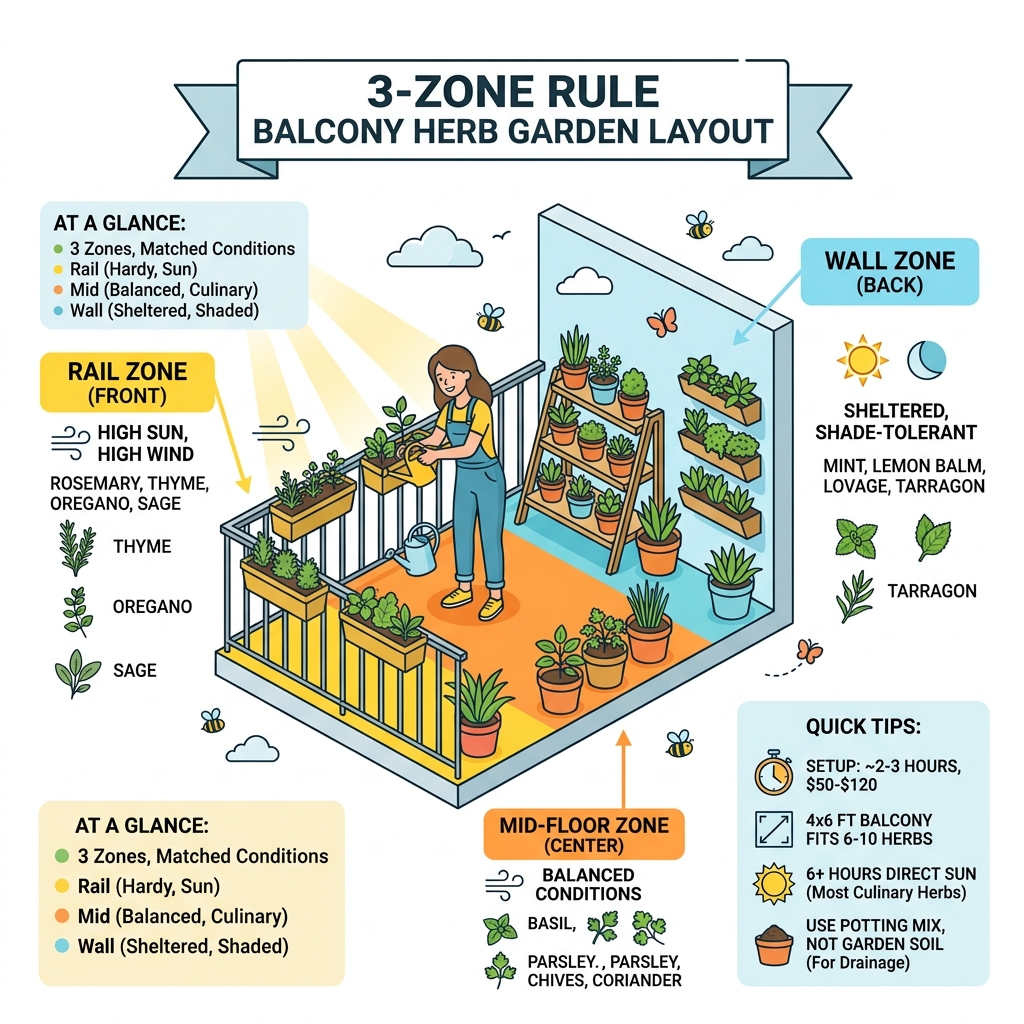
The 3-Zone Balcony Herb Garden Layout at a Glance:
- Rail zone (front) – Most sun and wind; plant hardy herbs like rosemary, thyme, and oregano
- Mid-floor zone (center) – Balanced conditions; ideal for basil, parsley, and chives
- Wall zone (back) – Most sheltered; perfect for mint, lemon balm, and shade-tolerant herbs
Quick setup facts:
- Setup takes roughly 2-3 hours and costs $50-$120
- A 4×6 ft balcony fits 6-10 herbs using railing planters and a tiered stand
- Most culinary herbs need 6+ hours of direct sun per day
- Always use potting mix, not garden soil — garden soil compacts and blocks drainage in containers
You don’t need a yard. You don’t even need a lot of money. A small balcony, a few pots, and the right plan are all it takes to grow fresh herbs steps from your kitchen.
The problem most people run into isn’t a lack of space — it’s a lack of a plan. Herbs get crammed together without thinking about their water or light needs. Mint takes over. Basil dies from wind, and gets blamed on heat. Mediterranean herbs drown in soil that holds too much moisture.
This guide fixes all of that. We’ll walk you through exactly how to assess your balcony, group your herbs smartly, and design a layout that actually works — whether you’re renting, starting from scratch, or just tired of buying wilted supermarket herbs.
Assessing Your Space for a Balcony Herb Garden Layout
Before we buy a single bag of soil, we need to play detective. Every balcony has its own “microclimate.” A south-facing balcony in the sun is a completely different world compared to a north-facing one tucked in the shadows. To create a successful balcony herb garden layout, we must understand the environmental forces at play.
Start by tracking your sunlight for one full day, from 8 AM to 6 PM. Most culinary herbs are sun-worshippers, requiring at least 6 hours of direct light. If you have a south-facing balcony, you likely have the “golden stretch” of 6-8+ hours. If you face north, you might only see 0-2 hours, which means we’ll need to pivot toward shade-tolerant varieties.
Don’t forget the wind! Higher-floor balconies can be wind tunnels. Wind dries out soil faster than heat does and can physically snap tender stems. We also need to consider weight limits; while herbs are small, large pots filled with wet soil can get heavy. Finally, understanding-sunlight-needs-for-balcony-plants is the foundation of your design. If you’re a renter, your layout needs to be non-permanent—meaning no drilling into the building’s exterior.

Maximizing Sunlight in Your Balcony Herb Garden Layout
If your balcony is a bit stingy with the sun, don’t panic. We can use a few “hacker” tricks to bounce light around. Reflective surfaces are your best friend. Placing white-painted lattices or even strategically positioned outdoor mirrors can reflect rays back onto your plants.
Using light-colored pots (like white or light gray) also helps, as dark pots can absorb too much heat, reaching internal temperatures of over 120°F and “cooking” the roots. For those with shifting shadows, mobile planters on wheels allow you to chase the sun throughout the day. If you are looking for high-quality starter plants, the Bonnie Plants Foundation offers standard 19.3 fl oz pot sizes that are perfect for getting a head start on your sunny balcony.
Designing a Renter-Friendly Balcony Herb Garden Layout
Renting shouldn’t stop you from having a lush oasis. We advocate for a minimalist-balcony-garden-design that relies on freestanding structures. Tension rods can be wedged between the floor and ceiling to hold small hanging pots, and suction cup shelves can turn your glass balcony door into a vertical nursery.
Freestanding shelving units and railing planters that clip onto the balustrade are excellent “no-drill” solutions. These allow you to maximize your footprint without losing your security deposit. For a budget-friendly-balcony-gardening-setup, look into upcycling items like old wooden ladders or crates—just ensure you add drainage holes!
Choosing Your Squad: Best Herbs and Grouping Strategies
One of the biggest mistakes beginners make is planting “The Loners” with “The Party Animals.” Every herb has a personality. Mint is a bully; its roots spread with the determination of a landlord collecting rent, so it must always live in its own isolated pot.
To make your balcony herb garden layout efficient, we group plants by their thirst levels. Mediterranean herbs (the “Dry Squad”) like rosemary, sage, and thyme love well-drained soil and can handle a bit of neglect. Soft-stemmed herbs (the “Thirsty Squad”) like basil, parsley, and cilantro want consistent moisture. Check out the-best-herbs-for-balcony-gardening to see which varieties fit your cooking style.
The 3-Pot Formula for Beginners
If you’re feeling overwhelmed, follow our “3-Pot Formula.” It’s the smartest way to start without overcomplicating things:
- The Sun-Lover: Basil or Oregano (needs 6+ hours of sun).
- The Shade-Tolerant: Mint or Chives (can handle 3-4 hours).
- The Bridge Herb: Parsley or Rosemary (flexible and hardy).
You can even try the supermarket herb hack: buy those “living herb” pots for a couple of dollars. Most people don’t realize these pots actually contain 5-15 overcrowded seedlings. If you tip out the root ball and gently tease them into 3 or 4 separate clumps, you’ll have multiple thriving plants for the price of one! For more tips on selection, read the-best-herbs-for-balcony-gardening-2.
Grouping Herbs by Watering and Soil Needs
Herbs from the Lamiaceae family (Rosemary, Thyme, Oregano) are the perfect roommates because they all prefer grittier soil and less frequent watering. On the flip side, moisture-loving chives and cilantro should be grouped together.
Expert herb growers, like those who follow Jekka’s tips for the balcony herb gardener, suggest using terracotta pots for the Dry Squad because the material “breathes,” helping soil dry out faster and preventing root rot. For the Thirsty Squad, plastic or glazed ceramic pots help retain the moisture they crave.
| Herb Type | Sunlight | Watering | Soil Type |
|---|---|---|---|
| Rosemary | Full Sun | Low (Dry) | Gritty/Sandy |
| Basil | Full Sun | Medium | Rich Potting Mix |
| Mint | Partial Shade | High | Moisture Retaining |
| Parsley | Partial Sun | Medium | Rich Potting Mix |
| Chives | Partial Sun | High | Rich Potting Mix |
Space-Saving Balcony Herb Garden Layout Ideas
When floor space is at a premium, we look up. maximizing-limited-space-with-balcony-gardening is all about verticality. By using the height of your balcony walls or railings, you can grow a dozen varieties in the footprint of a single chair.
Vertical gardening isn’t just a trend; it’s a necessity for urban dwellers. From tiered shelving to vertical-balcony-garden-ideas like hanging gutters, the options are endless.
Vertical Gardening and Creative Containers
One of our favorite tricks is using stackable, space-saving herb planters. These allow you to water the top tier and let the excess trickle down to the lower levels. Pocket planters made of felt or recycled plastic can be hung directly on a wall or over a door, creating a “living wall” effect.
If you have a bit of DIY spirit, a pallet garden is a classic. Just ensure the wood hasn’t been chemically treated. For those who want something ready-made, a 3 Tier Stackable Garden can hold up to 12 plants in a very small area. When choosing-the-best-vertical-garden-for-balcony-spaces, always consider how you will reach the top plants for harvesting!
The 3-Zone Rule for Small Balconies
To keep your balcony herb garden layout organized, follow the 3-Zone Rule:
- Rail Zone: Use railing planters for sun-loving, hardy herbs like thyme. They act as a natural “wind buffer” for the rest of your garden.
- Mid-Floor Zone: This is where you place a Tuenort Vertical Raised Garden Bed. It’s easy on the back and keeps your most-used herbs (like basil) at waist height.
- Wall Zone: Use the back wall for shelving. This area is the most sheltered from wind and harsh midday sun, making it perfect for delicate greens or mint.
Essential Care: Soil, Watering, and Maintenance
The secret to a thriving garden isn’t a “green thumb”—it’s good drainage. Never use garden soil from a yard; it’s too heavy and will compact in a pot, suffocating your plants. Always use a high-quality potting mix. For Mediterranean herbs, we recommend mixing 60% potting mix with 40% perlite or grit to ensure they never sit in “wet feet.”
Having the essential-balcony-garden-tools-you-must-have makes maintenance a breeze. A small pair of snips for pruning and a watering wand are must-haves. To keep your herbs productive, use fertilizer powders dissolved in water every 2-4 weeks during the growing season.
Watering Strategies Without an Outdoor Tap
Most balconies don’t have a hose bib, which means we become the “water couriers.” To make this easier, use self-watering pots which have a reservoir at the bottom. Another sustainable hack is using kitchen rinse water (like the water used to wash spinach or berries) to give your plants a drink.
Always use the “finger test”: stick your finger 3cm into the soil. If it feels dry, it’s time to water. Water in the morning so the plants can hydrate before the sun hits its peak. If you have a massive harvest, you can preserve herbs in olive oil and freeze them in ice cube trays for year-round flavor.
Troubleshooting Common Balcony Problems
Balcony gardens face unique challenges. Aphids and mealybugs love the sheltered environment. If you spot them, don’t reach for harsh chemicals. Insecticidal soaps or a simple mix of one teaspoon of mild dish soap per liter of water can clear them up.
Wind is the silent killer. If your herbs are wilting but the soil is wet, they might be stressed by the breeze. Use protective wire cages or move them closer to the wall. For community-sourced advice, the Twitter gardening community is a great place to ask for help when your leaves start turning yellow or purple (usually a sign of nutrient depletion).
Seasonal Success and Overwintering
Your balcony herb garden layout should change with the seasons. Annuals like basil and cilantro will naturally die off when the first frost hits. However, perennials like chives, mint, and rosemary (in warmer zones) can survive the winter with a little help.
In late autumn, move your pots against the warmest wall of the house. You can wrap pots in bubble wrap or burlap to insulate the roots. For visual inspiration on how to style your winter garden, check out Instagram or the Facebook page of expert herb farms. When spring returns, you can decide whether to start from seeds (cheaper but slower) or buy established seedlings for instant gratification.
Frequently Asked Questions about Balcony Herb Garden Layouts
What is the easiest herb to grow on a balcony?
Chives are arguably the easiest. They are incredibly hardy, tolerate partial shade, don’t mind a bit of over-watering, and come back year after year. Mint is also nearly indestructible, provided you keep it in its own pot so it doesn’t colonize the rest of your garden.
How many herbs can I fit on a small 4×6 balcony?
Using a smart balcony herb garden layout, you can easily fit 6-10 different herbs. By utilizing one tiered plant stand, two railing planters, and a few pots on the floor, you can have a full culinary spice rack without losing space for a bistro chair.
Can I grow herbs on a north-facing or shady balcony?
Yes! While you might struggle with rosemary or basil, shade-tolerant herbs like mint, parsley, chives, lemon balm, and cilantro will still produce. They may grow a bit slower, but they will still be delicious. You can also supplement with a small LED grow light if your balcony is particularly dark.
Conclusion
At Finance Lixo, we believe that urban sustainability starts right outside your door. Planning a balcony herb garden layout isn’t just about saving money on groceries—it’s about the therapeutic joy of watching something grow and the unmatched flavor of fresh-picked basil on your pasta.
Whether you have a sprawling terrace or a tiny 3m² ledge, there is a layout that works for you. Take it one pot at a time, group your “squads” by their needs, and don’t be afraid to experiment. For more deep dives into specific designs, visit our guide on balcony-herb-garden-design. Happy gardening!
