
The Best Tools to Check Soil Moisture and Prevent Underwatering
Why Getting Watering Right Is Harder Than It Looks
Moisture meters for plants are simple tools that measure how much water is in your soil — so you stop guessing and start watering with confidence.
Here are the best types to consider, based on your needs:
| Type | Best For | Battery Needed? | Price Range |
|---|---|---|---|
| Analog single-probe | Beginners, indoor pots | No | $10–$20 |
| Digital 3-in-1 (moisture/light/pH) | Indoor + outdoor use | No | $15–$35 |
| Digital 4-in-1 (+ temperature) | Advanced gardeners | Yes | $25–$70 |
| Smart sensor (app-connected) | Hands-off monitoring | Yes | $40–$120 |
Most apartment gardeners do just fine with a basic analog or 3-in-1 digital meter in the $10–$30 range.
Here’s the problem most plant owners face: the top layer of soil dries out fast, while the roots are still sitting in water. You water again. The roots rot. The plant dies. Sound familiar?
The reverse happens too. Soil can look perfectly dark and damp on the surface while the root zone is bone dry — especially in larger pots.
Your eyes and fingers only tell you what’s happening at the surface. A moisture meter reads what’s happening where it actually matters: deep in the root zone.
Over 43,000 people have reviewed just one popular 3-in-1 soil meter on Amazon alone — which tells you how many gardeners have already made this small but game-changing switch in how they care for their plants.
For anyone growing in a small apartment or on a balcony, where every plant has to earn its space, knowing exactly when to water isn’t just helpful — it’s the difference between a thriving little garden and a shelf full of sad, struggling pots.
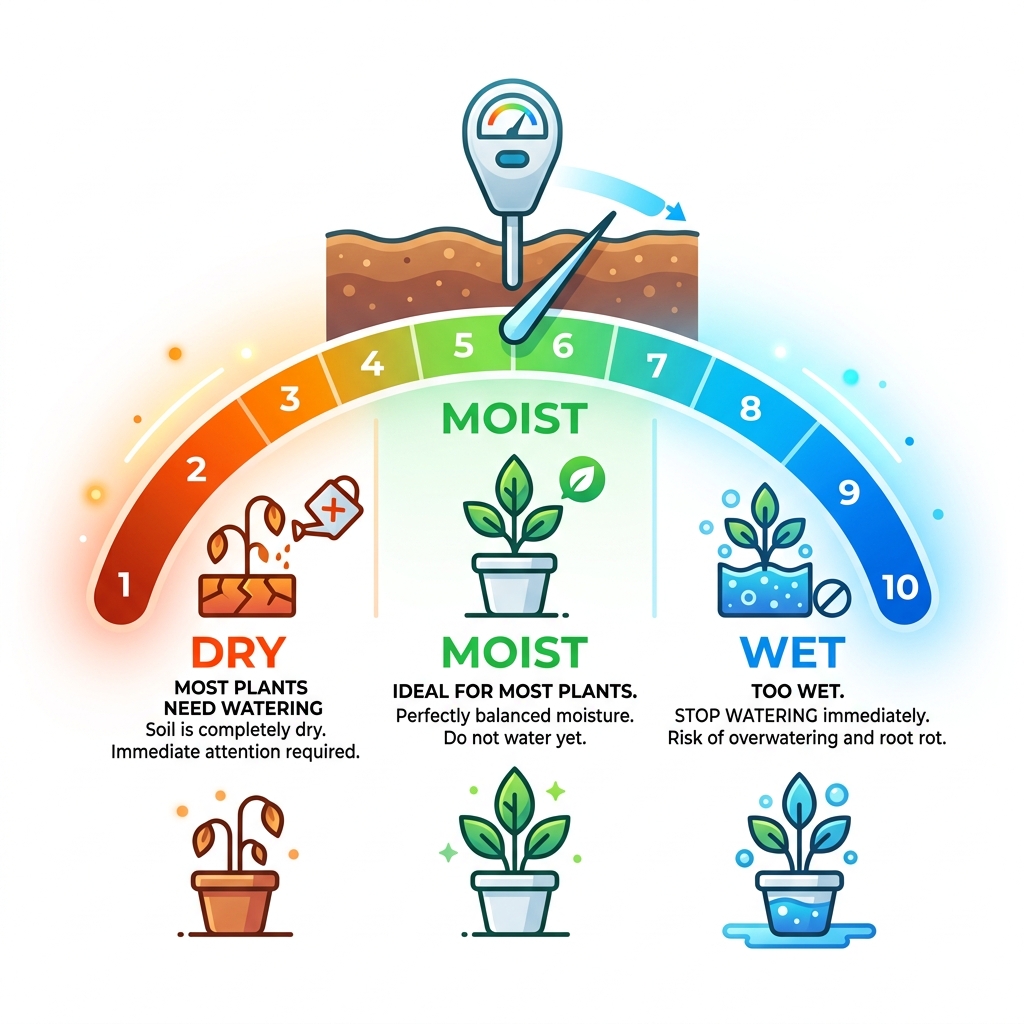
Why Every Indoor Gardener Needs a Moisture Meter for Plants
We have all been there: staring at a Fiddle Leaf Fig, wondering if that slight droop means “give me a drink” or “I’m drowning.” The truth is, guessing is the leading cause of houseplant homicide. Using a moisture meter for plants takes the intuition out of the equation and replaces it with data.
One of the biggest threats to your indoor jungle is root rot. This happens when soil stays saturated for too long, preventing oxygen from reaching the roots. Without oxygen, roots literally suffocate and begin to decay. On the flip side, underwatering can lead to “hydrophobic soil,” a condition where the soil becomes so dry it actually repels water. You might pour a cup of water in, see it run out the bottom, and assume the plant is hydrated—when in reality, the water just bypassed the root ball entirely.
A moisture meter helps you identify these hidden pockets of dryness. By checking multiple spots in a pot, you ensure the entire root system is getting the hydration it needs. This is particularly important when using essential balcony garden tools you must have to maintain a thriving outdoor space. Consistent moisture monitoring improves soil aeration and significantly extends the longevity of your plants, making you look like a pro even if you’ve only just started your gardening journey.
Choosing the Right Technology: Analog vs. Digital
When you start shopping for a moisture meter for plants, you’ll quickly notice two main camps: the simple analog sticks and the high-tech digital displays. Both have their place in our gardening kits, but they function quite differently.
| Feature | Analog Meters | Digital/Smart Meters |
|---|---|---|
| Power Source | No batteries (Galvanic) | Batteries (AAA, CR2032, or Solar) |
| Display | Needle and dial | LCD screen or Smartphone App |
| Durability | High (fewer electronic parts) | Moderate (screens can be sensitive) |
| Precision | General zones (1-10) | Exact percentages (VWC) |
| Best Use | Quick spot checks | Detailed monitoring & data logging |
Analog meters are the workhorses of the plant world. They don’t require batteries because they rely on a simple chemical reaction. When the two different metals in the probe (usually copper and aluminum) touch moist soil, they create a tiny amount of electricity. The wetter the soil, the stronger the current, which moves the needle.
Digital meters, like the YAMRON 4-in-1, often provide more precise readings, such as Volumetric Water Content (VWC). Some professional-grade models, like the Vegetronix Digital Meter, use transmission line techniques that aren’t affected by soil salinity, making them much more accurate for scientific watering.
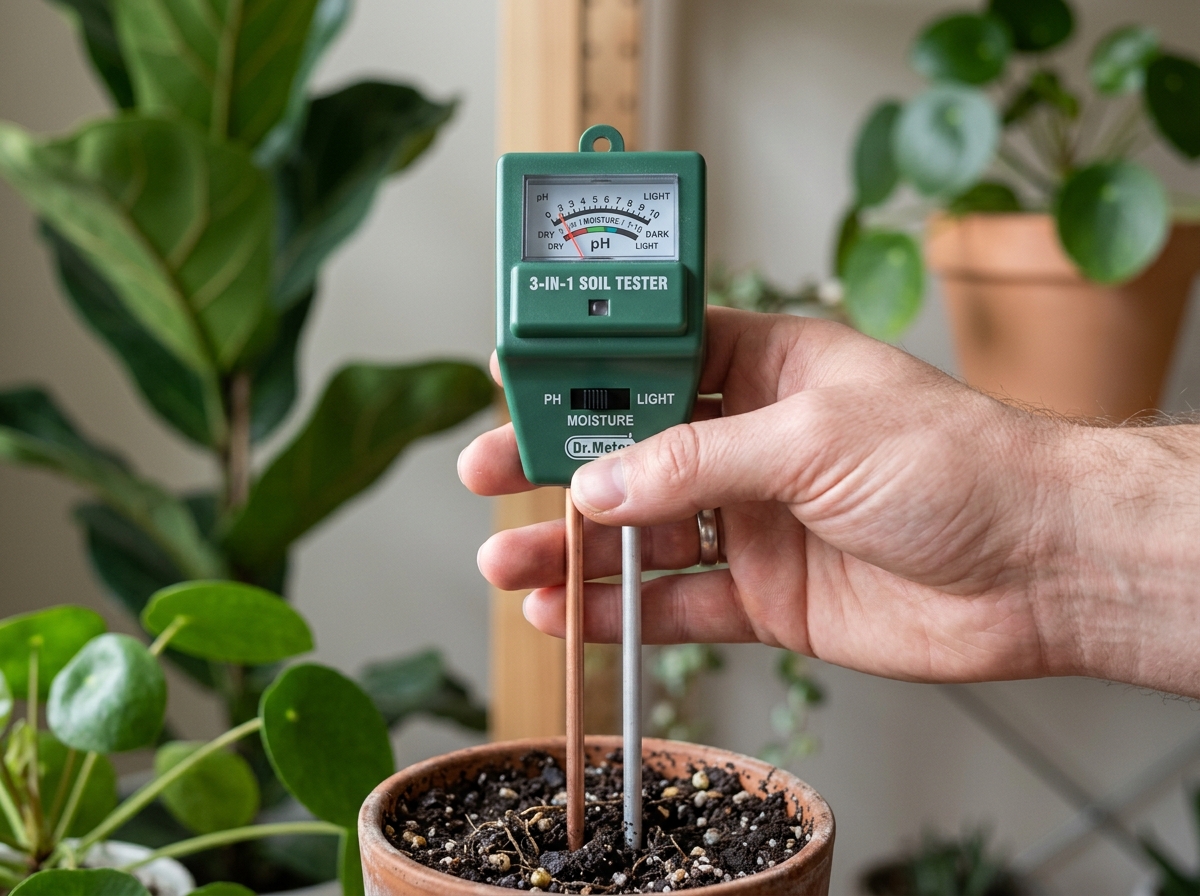
Single-Function Moisture Meter for Plants
If you just want to know if your Pothos is thirsty, a single-function meter is your best friend. These are typically budget-friendly and incredibly easy to use. Models like the XLUX Soil Moisture Meter feature a single stainless steel probe which causes less root damage than dual-probe models. They provide instant readings on a simple 1-10 scale, divided into Red (Dry), Green (Moist), and Blue (Wet) zones. We love these for their simplicity—just plug, read, and pull.
Multi-Function 3-in-1 and 4-in-1 Devices
For those of us who want to dive deeper into plant care, multi-function devices offer a “garden laboratory” in your pocket. A 3-in-1 meter, such as the one offered by The Sill, measures moisture, pH levels (acidity), and light intensity.
Stepping up to a 4-in-1 device adds soil temperature to the mix. These often feature large LCD screens with backlights, making them easy to read in dark corners or bright sun. Some even have 45-degree rotating heads so you don’t have to bend down to see the results. These tools are invaluable for checking if your “low light” corner is actually a “no light” corner.
How to Use a Moisture Meter for Plants Accurately
Buying the tool is only half the battle; using it correctly is what saves the plants. Many people make the mistake of just poking the surface. To get a real reading, you need to reach the root zone.
- Insert Deeply: Push the probe about 2-4 inches (or 10cm) into the soil. For larger pots, you may need to go deeper to reach the center of the root ball.
- Avoid Obstacles: If you hit a rock or a thick root, don’t force it. Move over an inch and try again. Forcing the probe can damage the sensor or the plant’s root system.
- Wait for Stability: On analog meters, wait a few seconds for the needle to stop moving. On digital models, it may take 10 seconds to a minute for the reading to stabilize.
- Take Multiple Readings: Soil isn’t always uniform. Check 2-3 different spots around the plant and average the results.
- Clean the Probe: This is the most important step! After every single use, wipe the probe with a clean, dry cloth. This prevents the buildup of minerals and stops the spread of soil-borne diseases between your plants.
Using these techniques alongside your other balcony garden tools will ensure your urban oasis stays healthy and vibrant.
Top-Rated Soil Moisture Monitors for Every Budget
Based on thousands of customer reviews and hands-on testing by gardening experts, several models consistently rise to the top. Whether you are looking for a bargain 5-pack or a high-tech sensor, there is an option for you.
- The Crowd Favorite: The Suplong Soil Moisture Meter is a staple on Amazon, boasting over 5,700 reviews with a 4.3-star average. It’s a classic analog 3-in-1 that gets the job done without any fuss.
- The Precision Digital: For those who prefer numbers over needles, the RainPoint Digital Meter offers a compact design that is perfect for both indoor and outdoor use.
- The Professional Choice: The Blumat Digital Moisture Meter is unique because it uses a ceramic “carrot” to measure soil tension (in mbars). It’s highly accurate and preferred by those growing in “living soil” where keeping microbes happy is a priority. You can find it at Blumat USA.
- The Bulk Buy: If you have a massive collection, companies like Léon & George offer 5-packs of moisture meters, ensuring you always have one handy for every room.
- The Retail Reliable: If you prefer shopping in person, the Luster Leaf Rapitest is a consistent best-seller at Home Depot, known for its durability and straightforward interface.
Frequently Asked Questions about Soil Testing
Do moisture meters require batteries?
It depends on the model. Most basic moisture meters for plants (analog types) do not require batteries. They operate via a galvanic reaction between the metal probe and the soil. However, digital models with LCD screens, backlights, or Bluetooth connectivity will require power—usually AAA batteries or a CR2032 coin cell. Some high-end outdoor sensors are solar-powered to save you the hassle of replacements.
Can a moisture meter for plants measure pH and light?
Yes, many “3-in-1” and “4-in-1” models are designed to do exactly that. The pH sensor helps you determine if your soil is too acidic or alkaline for specific plants (like Blueberries or Hydrangeas). The light sensor measures the intensity of the sun hitting that specific spot, which is great for verifying if your “bright indirect light” is actually sufficient. Just keep in mind that the pH sensors on budget meters are often less accurate than professional lab tests.
How do I maintain my moisture meter for long-term use?
The biggest enemy of a moisture meter is oxidation. If you leave a probe in the soil, the metal will corrode, and the meter will stop working.
- Never leave it in the soil: Take your reading and remove it immediately.
- Wipe it dry: Use a paper towel or cloth after every use.
- Avoid liquids: These meters are designed for soil. Dipping them directly into a glass of water can actually damage the sensors or give you a false “dry” reading.
- Sand it lightly: If the probe becomes dull or oxidized over time, a very light rub with fine sandpaper or steel wool can often restore its sensitivity.
Conclusion
At Finance Lixo, we believe that success in apartment gardening shouldn’t be a mystery. Investing in a moisture meter for plants is one of the smartest, most affordable moves you can make to ensure your indoor garden thrives. By moving away from guesswork and toward a data-driven approach, you can prevent the heartbreak of overwatering and enjoy the lush, green sanctuary you’ve worked so hard to create.
Whether you choose a simple analog stick or a high-tech digital sensor, the goal remains the same: sustainable, happy plants. Ready to level up your green thumb? Start your gardening journey today and turn your small space into a flourishing oasis.
