
The Ultimate Guide to Monstera Light Needs
Can Monstera Deliciosa Survive in Low Light?
Monstera deliciosa low light conditions are something this popular houseplant can tolerate — but there’s an important difference between surviving and thriving.
Here’s the quick answer:
- Yes, Monstera deliciosa can live in low light — it won’t die immediately
- No, it won’t produce its iconic split leaves (fenestrations) without brighter light
- Growth slows significantly — less than 12 inches per year signals insufficient light
- Leaves stay small and solid, resembling juvenile foliage rather than the dramatic Swiss Cheese look
- Soil stays wet longer, which raises the risk of root rot
- Yellowing leaves are a common sign the plant is struggling
If you have a north-facing room or a dim corner in your apartment, your Monstera will survive — but it will look more like a basic green plant than the lush, fenestrated showpiece you see on social media.
The good news? A few simple adjustments — placement, watering habits, and optional grow lights — can make a real difference even in shadier spaces.
This guide covers everything you need to know about growing Monstera deliciosa in low light conditions, from defining what “low light” actually means to practical care tips for keeping your plant healthy without a sun-drenched window.
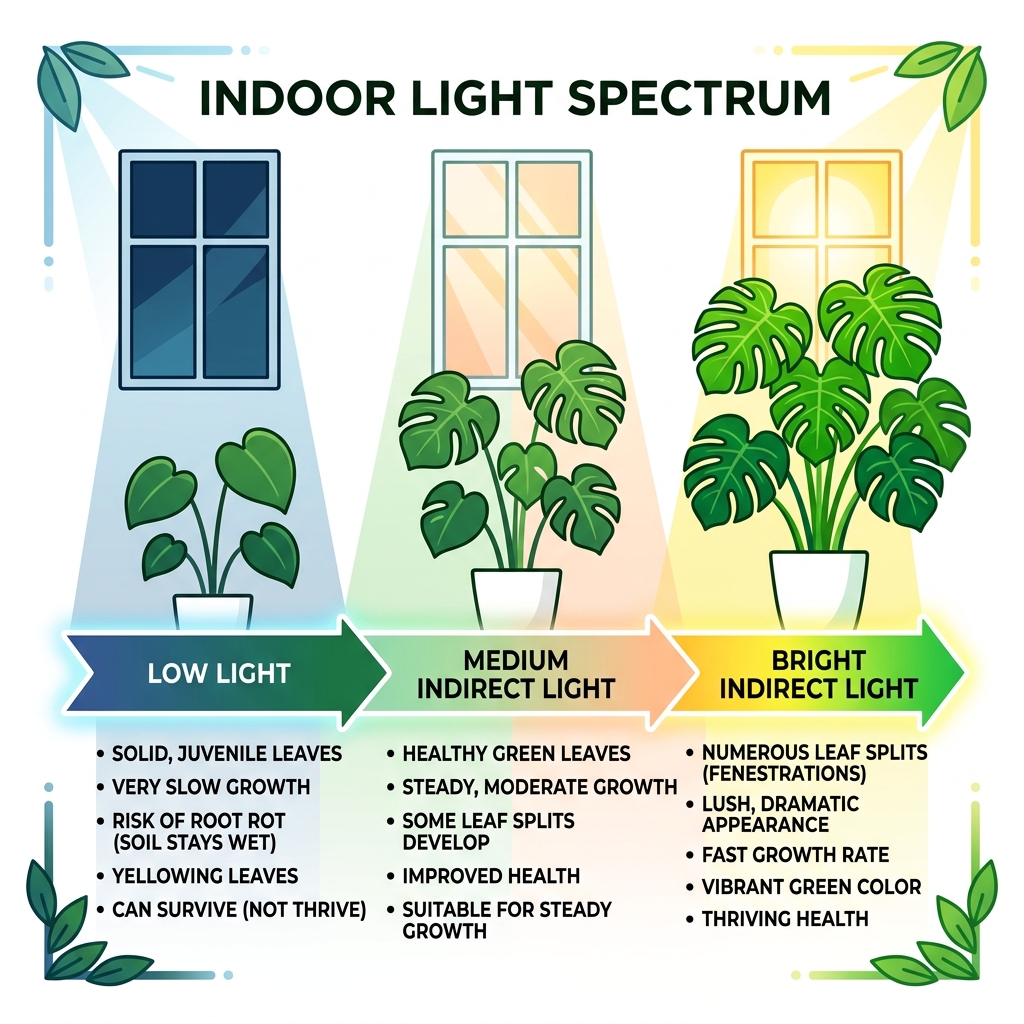
Defining Monstera Deliciosa Low Light Conditions
When we talk about “low light” in indoor gardening, we aren’t talking about a windowless basement or a dark closet. All plants, including the resilient Monstera, need light to perform photosynthesis—the process of turning light into the energy they need to grow. Without it, the plant is essentially starving.
In a home setting, monstera deliciosa low light typically refers to areas that receive less than 150 to 200 foot-candles (fc) of light. For context, “bright indirect light” usually sits between 400 and 800 fc. If you find yourself in a room where you can easily read a book during the day without flicking on a lamp, but you can’t see a distinct shadow of your hand on the wall, you’re likely in a low-light zone.
North-facing windows are the classic example of low-light spots. They provide a soft, consistent glow throughout the day but never receive the “punch” of direct sun. While this is great for preventing leaf scorch, it often leaves a Monstera wanting more. To get a better handle on how light works in your home, check out our guide on understanding sunlight needs for balcony plants.
Identifying a Monstera Deliciosa Low Light Environment
To accurately identify if your plant is in a monstera deliciosa low light spot, we recommend using a “shadow test.” Stand between your plant and the light source (the window) and look at the shadow cast on the wall or floor.
- Sharp, well-defined shadow: High light.
- Soft, blurry shadow: Medium light.
- Faint or non-existent shadow: Low light.
Distance from the window also plays a massive role. Light intensity drops off exponentially the further you move into a room. A spot just five feet away from a window might receive only 25% of the light available right at the glass. Seasonal shifts are another factor; a bright corner in July might become a dark “danger zone” in December when the sun sits lower in the sky. If you are dealing with a particularly dim space, you might find our gardening without sunlight tips for shady balconies helpful for choosing other plants that can handle the gloom.
Comparing Low Light vs. Bright Indirect Light
In their native habitats of Southern Mexico and Central America, Monsteras are epiphytes that climb up trees to reach the canopy. They are naturally adapted to “dappled” light—bright but filtered.
When we place them in low light, their physiology changes. The plant will produce more chlorophyll to try and capture every stray photon of light, which often makes the leaves a darker, deeper green. However, because the energy storage is low, the growth speed crawls. In bright indirect light, a healthy Monstera might push out a new leaf every few weeks during the growing season. In low light, you might only see one or two leaves a year.
| Feature | Low Light (<200 fc) | Bright Indirect Light (400-800 fc) |
|---|---|---|
| Growth Rate | Very slow (<12 inches/year) | Rapid (4-6 new leaves/year) |
| Leaf Size | Small, juvenile | Large (up to 3 feet wide) |
| Fenestrations | Little to none | Dramatic splits and holes |
| Node Spacing | Long, “leggy” stems | Compact, sturdy stems |
| Chlorophyll | High density (dark green) | Balanced |
How Light Intensity Affects Growth and Fenestrations
The most famous feature of the Monstera deliciosa is its fenestrations—those beautiful splits and holes that give it the “Swiss Cheese” nickname. Biologists believe these holes allow the plant to withstand heavy tropical rains and let light pass through to lower leaves.
However, fenestrations are “expensive” for the plant to produce. It takes a lot of energy to grow those complex leaf patterns. In a monstera deliciosa low light environment, the plant prioritizes survival over style. It will produce solid, heart-shaped leaves that look more like a common Pothos. This is the plant’s way of maximizing surface area to catch light. If your heart is set on those dramatic splits, light is the primary “trigger” you need to provide.
When light is too low, the plant also undergoes “etiolation.” This is a fancy word for stretching. The plant will grow long, weak stems (internodes) as it desperately reaches toward the nearest light source. This leads to a floppy, “leggy” appearance that often requires heavy staking. For those looking to fill shady spots with something naturally suited for lower light, you might consider the best flowers for a shaded balcony.
Signs Your Monstera Deliciosa Low Light Spot is Insufficient
How do you know if your Monstera is just “chilling” in the shade or actually suffering? We look for several red flags:
- Leggy Stems: If there are several inches of bare stem between each leaf, your plant is “walking” toward the light.
- Yellowing Leaves: While yellowing can mean many things, in low light, it often signifies the plant is “retiring” its oldest leaves because it doesn’t have the energy to maintain them.
- Small, Solid Leaves: If new growth is consistently smaller than the older leaves and lacks any splits, the light is too low.
- Soil That Won’t Dry: If the soil is still damp three weeks after watering, the plant isn’t photosynthesizing fast enough to use the water. This is the #1 precursor to root rot.
If you see these signs, it’s time to move the plant or supplement with light. Sometimes, simply rotating the plant a quarter-turn every week can help prevent it from leaning too heavily. For more inspiration on shade-tolerant beauties, check out the best flowers for a shaded balcony-2.
Why Variegated Varieties Struggle in the Shade
If you own a ‘Thai Constellation’ or an ‘Albo Variegata’, the monstera deliciosa low light rules change completely. Variegated plants have white or cream-colored patches that contain no chlorophyll. These sections are essentially “dead weight” when it comes to energy production.
Because a variegated Monstera has less green surface area, it needs significantly more light to produce the same amount of energy as a fully green plant. If you put an Albo in a dark corner, the plant may “revert” (start growing solid green leaves) to save itself, or the white patches may turn brown and crispy as the plant decides it can no longer support those non-productive cells. For these high-end varieties, bright indirect light is a requirement, not a suggestion.
Care Adjustments for Low-Light Monsteras
If you must keep your plant in a lower light area, we have to adjust our “standard” care routine. You cannot treat a low-light Monstera the same way you treat one sitting in a sunny window.
The most critical adjustment is watering. In low light, the plant’s metabolism slows down. It drinks less water, and the lack of warmth from the sun means water evaporates from the soil much slower. We recommend using the “soak and dry” method but extending the “dry” period. Always check the top 2-3 inches of soil; if it’s even slightly damp, wait.
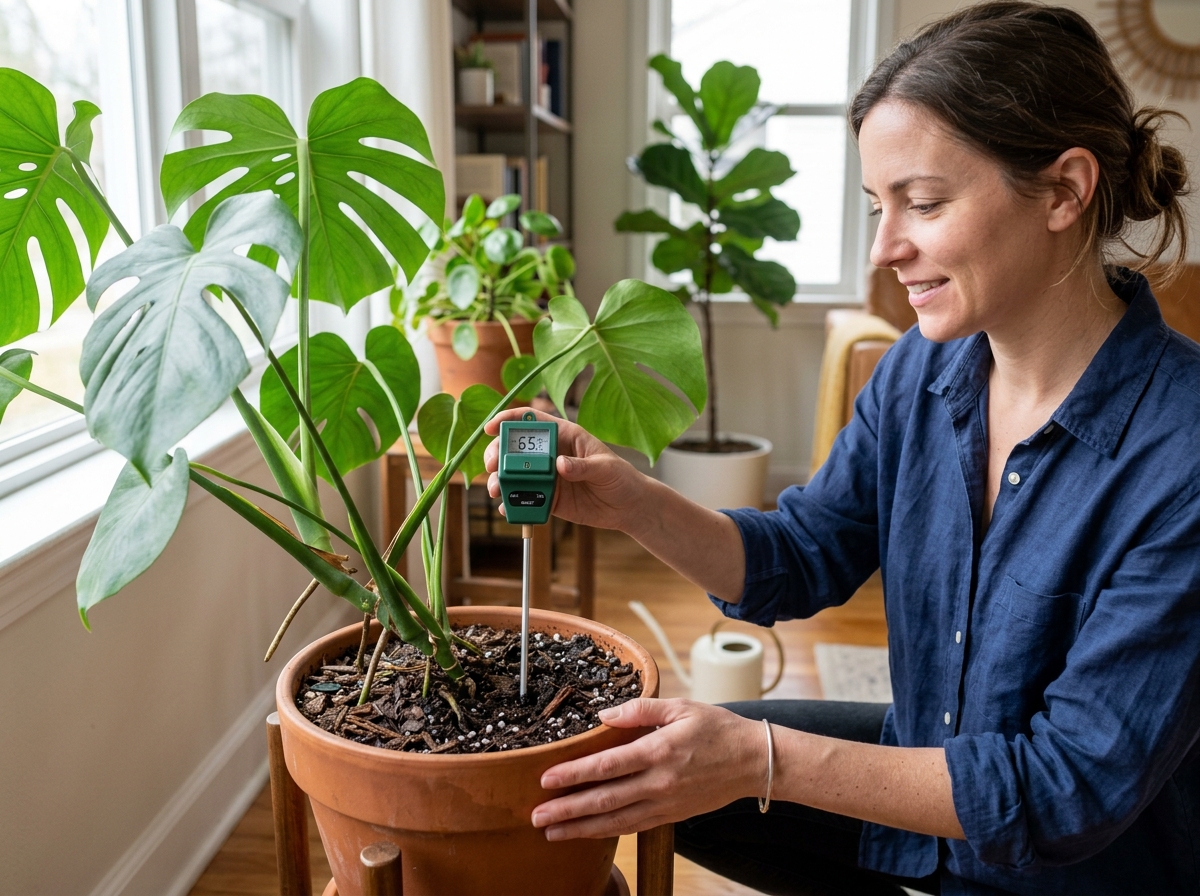
Overwatering causes roughly 87% of Monstera declines in indoor settings. In a dim corner, that risk sky-rockets. To help your plant thrive in these conditions, take a look at our list of the best indoor plants for your balcony, which includes many hardy options.
Soil and Potting Strategies for Shady Corners
For a monstera deliciosa low light setup, the soil mix is your best defense against root rot. We want a mix that is “chunky” and highly aerated. If you use standard, dense potting soil, it will hold onto moisture like a sponge, suffocating the roots.
We recommend a DIY “Aroid Mix”:
- 3 parts Orchid Bark: Provides structure and air pockets.
- 2 parts Perlite or Pumice: Ensures rapid drainage.
- 2 parts Coco Coir: Holds just enough moisture without becoming “mucky.”
- 1 part Horticultural Charcoal: Helps filter impurities and discourages fungal growth.
Also, avoid oversized pots. A common mistake is moving a plant into a huge pot to “give it room to grow.” In low light, a large pot means a large volume of wet soil that the roots can’t reach, which is a recipe for disaster. Keep the pot snug—only 1-2 inches wider than the root ball.
Managing Humidity and Temperature
Monsteras love a tropical vibe: warm and humid. They prefer temperatures between 65°F and 85°F. In low-light rooms, which are often cooler, make sure the plant isn’t sitting in a cold draft from an AC vent.
Humidity should ideally be above 60%. While Monsteras are “troopers” and can survive in 40% humidity, they won’t thrive. Since we can’t give them a lot of light, we should give them great humidity to compensate.
- Pebble Trays: A tray of water and stones under the pot can boost local humidity.
- Cool-Mist Humidifier: The most effective way to keep leaves happy.
- Grouping Plants: Plants “breathe” out moisture (transpiration), so huddling them together creates a micro-climate.
Avoid misting! Our research and experience show that misting only raises humidity for a few minutes and can actually encourage bacterial diseases on the leaves.
Using Grow Lights to Supplement Natural Shade
If your heart is set on a giant, fenestrated Monstera but your apartment only has one tiny window, grow lights are your new best friend. Modern LED grow lights are energy-efficient and can look quite stylish.
For a monstera deliciosa low light supplement, look for a “full-spectrum” LED.
- Color Temperature: Aim for around 5000K (this mimics natural daylight).
- Wattage: A 20W to 50W bulb is usually sufficient for a single plant.
- Distance: Place the light 18 to 24 inches above the top leaves.
- Duration: Run the light for 8 to 12 hours a day.
Using a grow light can “unlock” the plant’s ability to produce fenestrations even in the middle of a windowless room. It provides the Photosynthetically Active Radiation (PAR) that human eyes can’t always detect but plants crave.
Frequently Asked Questions about Monstera Light
Can a Monstera survive in a room with no windows?
Technically, no plant can survive in “zero light” indefinitely. If a room has no windows, you must use a grow light. Without supplemental LEDs, the plant will slowly use up its stored energy, the leaves will yellow, and it will eventually die. Think of light as the plant’s food—you can’t expect it to live without eating!
Why are my new Monstera leaves not splitting?
This is usually a combination of age and light intensity. If your plant is under two years old, it might still be in its juvenile phase. However, if it’s an older plant and the new leaves are solid, it’s a clear cry for more light. Providing a moss pole can also help; as the plant climbs, it feels more “secure,” which can trigger the production of larger, fenestrated leaves.
How do I move my Monstera to a brighter spot without burning it?
Acclimation is key! If you move a plant from a dark corner directly into a window with three hours of direct sun, the leaves will “bleach” or turn black from sunburn.
- Week 1: Move it a few feet closer to the window.
- Week 2: Move it to the edge of the bright light zone.
- Week 3: Place it in its final bright spot. Use sheer curtains to filter the light during the hottest part of the day to ensure a smooth transition.
Conclusion
Growing a monstera deliciosa low light style is entirely possible with the right mindset. At Finance Lixo, we believe that everyone deserves a touch of the tropics in their home, regardless of how many windows they have. By understanding the limits of shade, adjusting your watering habits, and perhaps enlisting the help of a modern grow light, you can keep your Swiss Cheese plant happy for years to come.
Remember: Observe, wait, and act. Watch how your plant responds to its environment, and don’t be afraid to tweak your routine. Ready to expand your indoor jungle? Start your indoor garden journey today and discover the joy of sustainable, green living!
